
You have already spent the money on cameras, cabling and a DVR or NVR. The problem is not coverage — it is that a recording nobody watches is a witness, not a guard. It helps you understand an incident after the fact, but it does nothing to stop one while it is happening. This is the gap AI closes: it turns a passive recorder into an active set of eyes that never blinks, never takes a break and never gets bored on the night shift.
The problem with ordinary CCTV
Walk into almost any factory, warehouse or office and you will find a bank of monitors that nobody is really looking at. Research on human attention has long shown that a person watching multiple screens misses most of what happens after the first several minutes — the mind simply wanders. So the cameras keep rolling, the footage keeps piling up, and the value only appears when there is a theft, an accident or a dispute and someone spends an afternoon scrubbing through hours of recording.
That reactive model has real costs. A trespasser is already inside before anyone notices. A safety violation is only caught during the post-incident review. A fire has minutes to spread before a person happens to glance at the right screen. The cameras were never the weak link — the missing piece is something watching the feeds live and raising a hand the instant it matters.
What AI video analytics detects
Modern AI video analytics runs on the live stream and understands what is in the frame — people, vehicles, movement, zones and conditions. Instead of just recording pixels, it recognises events and turns them into alerts your team can act on. Common detections that map directly to everyday business problems include:
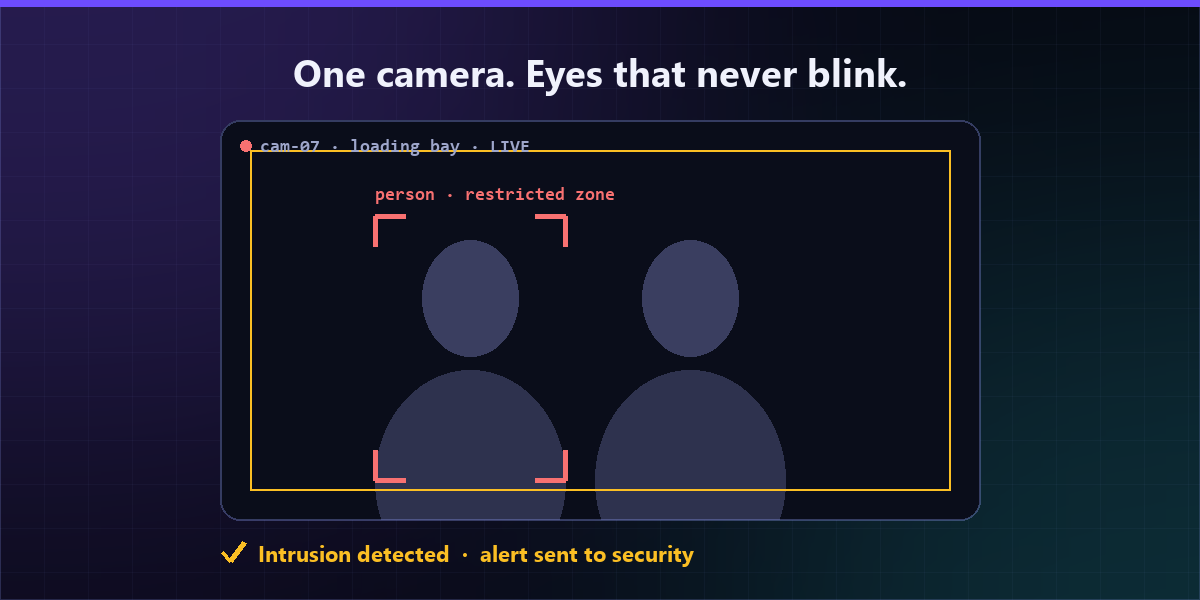
- Intrusion and trespass. Draw a virtual boundary around a restricted area, a perimeter fence or a store after hours, and the system flags anyone who crosses into it when they should not be there.
- Loitering. A person lingering near an ATM, a gate, a cash counter or a stockroom for longer than normal is surfaced before it becomes an incident.
- Crowd and occupancy. Count people in an area, watch for dangerous crowding at an exit, or keep a headcount for a zone that has a safe limit.
- PPE compliance. On a factory floor or construction site, the system can flag workers entering a hazard zone without a helmet or vest, helping supervisors enforce safety consistently rather than only when they happen to be watching.
- Fire and smoke. Visual detection of flame or smoke in the frame can raise an alarm early, adding a layer that works even where a traditional smoke detector is slow to react or absent.
Each of these is a rule you configure once, mapped to the camera and zone where it matters. You are not asking a guard to remember every policy on every screen — the software applies your rules to every frame at once.
It works on the cameras you already have
The most common worry is cost, and it is usually the easiest one to put to rest: in most cases you do not need to rip out and replace anything. AI video analytics connects to standard IP cameras over RTSP, and to ONVIF-compliant devices, which covers the vast majority of business CCTV already installed across India. The feed your recorder is receiving can also be sent to the analytics engine.
That means you can start on the cameras that matter most — the back gate, the stockroom, the assembly line — and prove the value before expanding. There is no forklift upgrade, no long procurement cycle for new hardware, and no disruption to the recording you already rely on. A few practical notes still apply: a reasonably clear view, decent lighting or IR for night, and a sensible camera angle make every detection more dependable, the same fundamentals that make ordinary CCTV useful in the first place.
Real-time alerts, not just recordings
Detection is only half the value; the other half is getting the right person to look at the right moment. When the system sees an event, it does not just log it — it pushes an alert to the people who can act. That can land in a dashboard, a mobile app, or a WhatsApp message, and it comes with the snapshot or short clip of exactly what triggered it. Your security supervisor sees the intrusion as it happens, with the frame attached, and can decide in seconds whether it is a stray dog or someone climbing the fence.
This is the difference between a witness and a guard. A recording tells you what happened yesterday. A live alert with a clip lets you stop what is happening now — dispatch a guard, lock a door, call for help, or simply confirm it was nothing. Because the alert carries visual context, your team is not chasing false alarms blind; they are making an informed call from the clip itself. Over time, the same event stream also becomes a clean, searchable record for audits and investigations, so you get both the real-time guard and the reliable historian from one platform.
Where it fits
The building blocks are the same, but the payoff looks different depending on the site:
- Factories and manufacturing. Enforce PPE, keep people out of machine hazard zones, and get early warning on fire or smoke near flammable stock.
- Warehouses and logistics. Watch perimeters and loading bays after hours, flag loitering near high-value inventory, and monitor restricted racking areas.
- Retail. Spot loitering near the till, monitor stockroom access, and understand footfall and occupancy across the floor.
- Construction and project sites. Secure an open perimeter that has no walls yet, and keep a live check on helmet and vest compliance.
- Housing societies and campuses. Guard common areas, parking and boundaries, and route anything unusual straight to the security desk.
Video analytics is also the natural companion to entry control. Pair it with access control so a door or turnstile opens only for authorised people, and add ANPR at the gate so vehicles are recognised and logged as they arrive. Together, the perimeter, the gate and the doors all feed one intelligent picture of what is happening on your site — and our video analytics platform is built to sit at the centre of it.
Getting started
You do not have to convert every camera at once. A sensible first step is to pick the one or two feeds where a live alert would make the biggest difference — the back gate, the restricted zone, the loading bay — and set up the rules that matter there. Send us a sample clip from your existing camera and we can tell you quickly what each feed will reliably detect and where a small change in angle or lighting would help.
From there you add cameras, add detections, and layer in gate and door control as the results speak for themselves. The end state is simple: the CCTV you already own stops being a recorder you check after the fact and becomes a security system that watches in real time and tells you the moment something needs you.
Ready to make your cameras work harder? Explore our video analytics platform to see how intrusion, loitering, PPE and fire detection come together, then book a demo and send a sample clip from your site — we will show you exactly what your feeds can catch.