
This is where AI has quietly become useful, and not in the science-fiction way. The wins that matter for a small or medium business are boring and concrete: a task that took a person an hour now takes a few minutes, or happens on its own overnight. Here are five of the most common ones we see across Indian offices, factories, clinics and shops — each tied to something you can start with the tools you already own.
1. Answering the same customer questions, all day
Every business has a short list of questions it answers a hundred times a week. What are your timings? Do you deliver to my pincode? What is the price? Is my order ready? A staff member replying to each one by hand is slow for the customer and expensive for you — and after 7pm, nobody replies at all, so those enquiries go cold.
A well-built AI agent handles this the moment a customer asks, on your website or WhatsApp, in the customer's own language, at 2am on a Sunday as readily as Monday morning. It knows your catalogue, your policies and your FAQs, and it hands off to a human the moment a query is genuinely complex. The saving is twofold: your team stops re-typing the same three answers, and you stop losing the after-hours enquiries that used to slip away. You can see how this works on our custom AI agents page, and we have a full walkthrough on putting an AI chatbot on your website.
2. Marking attendance by hand
Registers, punch cards, a queue at the fingerprint scanner at 9am — attendance is one of those chores that quietly costs a surprising amount. Someone reconciles the register with leave records, chases missing punches, and re-keys it all into payroll at month-end. Buddy-punching and honest mistakes make the numbers softer than anyone likes to admit.
Face recognition turns the whole thing into a walk-past. A staff member is recognised as they arrive, the time is logged automatically, and the record flows straight into HR without a spreadsheet in the middle. We have covered exactly how this works for face recognition attendance, and when it plugs into an HRMS, the same recognition that marks presence also feeds leave, shifts and payroll — so the hour your admin used to spend reconciling every month simply disappears.
3. Manual gate and parking entry
If a guard is copying number plates into a register, you are paying for slow entry and a log nobody can search. Visitors pile up behind the barrier, and when you need to know which vehicle came in at 4pm last Tuesday, you are flipping through a notebook.
Automatic number plate recognition reads the plate as the vehicle rolls up, checks it against your resident or staff list, and opens the barrier — no clipboard, no queue. Every vehicle leaves a timestamped, searchable record with a snapshot. Our ANPR solution does this on the cameras you already have at the gate, which is why societies, factories and paid parking lots reach for it first: it removes a person from a repetitive job and gives you a cleaner record than any register could. We go deeper in our guide to parking and gate automation.
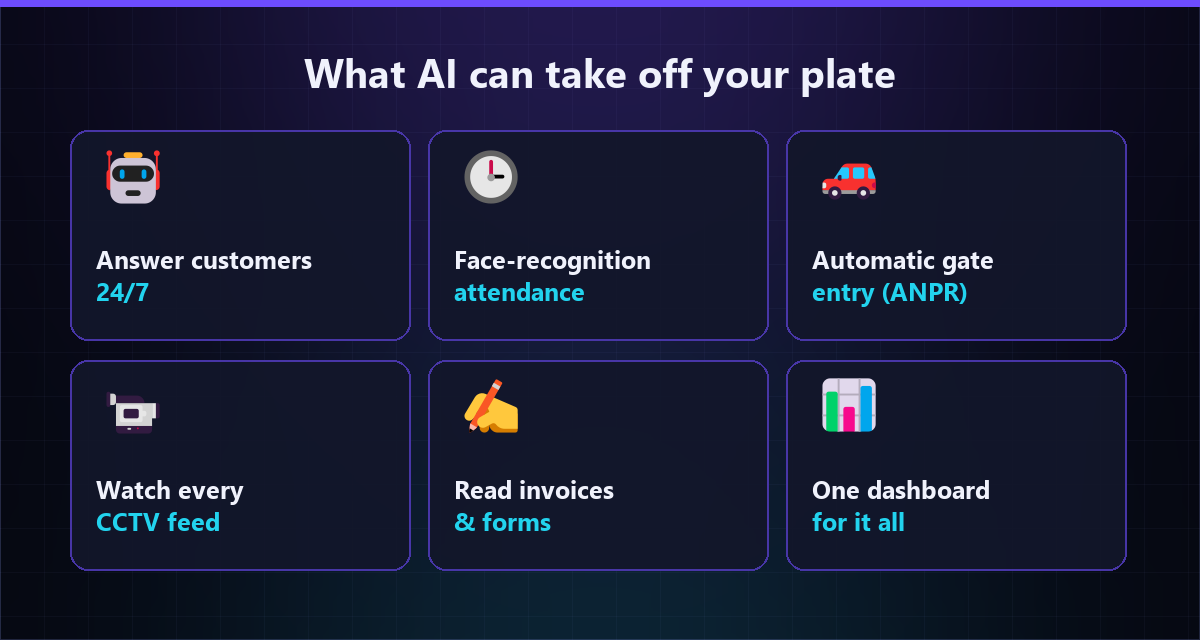
4. Nobody is actually watching the CCTV
Most businesses have cameras. Almost none have someone watching them in real time — the footage is only ever reviewed after something has already gone wrong. That makes CCTV a record, not a safeguard, and it means the incidents you could have caught early are the ones you find out about too late.
Video analytics turns those passive feeds into something that pays attention for you. The same cameras can watch for a person entering a restricted area after hours, count footfall in a retail aisle, flag a crowd building where it should not, or notice a vehicle parked where nothing should be. Instead of paying someone to stare at a wall of monitors, you get an alert only when something genuinely needs a human. It is the difference between reviewing what went wrong yesterday and being nudged about it while it is still happening — and because it runs on your existing CCTV cameras, you are not buying a new security system to get it.
5. Re-typing data from invoices and forms
The least glamorous cost in any office is data entry. Someone reads a supplier invoice and types the numbers into the accounts software. Someone copies details off a filled-in form into a system. Someone transcribes a stack of documents. It is slow, it is error-prone, and every mistake creates a second job later to fix it.
Document AI reads these for you. It extracts the fields you care about — invoice number, amount, GST, line items, names, dates — from a scan or a photo, and hands back clean, structured data ready to drop into your accounting or CRM. A human still checks the exceptions, but the bulk of the typing is gone. It is one of the quieter items in our range of AI solutions, and often the one with the fastest, most obvious payback for a back office drowning in paper.
Where to start
You do not need an AI strategy or a big budget to feel the first win. Pick the single task that annoys your team the most — the one everyone groans about — and automate just that. If it is after-hours enquiries, start with an agent. If it is the 9am attendance queue, start with face. If it is the gate, start with one lane.
The common thread across all five is that AI does the repetitive part so your people can do the part that actually needs a person. The technology mostly runs on tools you already own — your website, your cameras, your existing systems — so the cost of trying is low and the saving tends to show up quickly.
Not sure which one fits you best? That is exactly the conversation to have. Explore our custom AI agents and the wider AI solutions we build for Indian businesses, then book a demo and tell us where your team's time is going — we will point you at the one change that saves the most for the least.